Showing posts with label food. Show all posts

Friday, July 2, 2010

Top 10 Activities for a Healthy 4th of July

July 4th is almost here!  Here are my top 10 ideas for a healthy Independence Day. All of the recipe posts below are from this blog. They are vegan and meat-less dishes that won't ruin your diet.

1) Host an outdoor party for the family.

2) Have a picnic and get family and  friends together for a vegan barbecue. Grilling foods is much less fattening than frying. Add lots of vegetables to the menu, like raw salads and veggie kebabs. For dessert, watermelon is the perfect all-natural treat. Also try these delicious recipes below:

3) Make Frankie’s Vegan Spare Ribs - This recipe sounds tasty, and not too complicated. The meat substitute is seitan. It does call for a food processor, and about an hour of total baking time, which is not too bad. There is a BBQ sauce recipe that goes with the ribs.

4) Make Carolina-style Barbecue Sandwiches - From Vegetarian Times, this one I would like to try, but it calls for a lot of cider vinegar - try reducing it to 1/4 cup. The sauce is supposed to be tangy, and mustardy. The sandwich uses seitan as the protein source. (If you want the sweeter Kansas City BBQ sauce, here is a recipe for Big Al’s K.C. sauce.)

5) Make eco-friendly arts and crafts with family and friends.

6) Try Sweet and Spicy Barbecue Tofu - A simple but appealing recipe for comes from About.com. The only issue I see is the call for 3/4 cup brown sugar. That seems like too much, and could be reduced to maybe 1/4. Marinating takes 2 hours, but everything else is quick.

7) Make Eggplant BBQ with Fresh Chive Vinaigrette - This recipe sounds the most original. It also doesn’t require much time. When can you say you last barbequed an eggplant?

8) Cook up Brazilian Beach Skewers - For people who do eat cheese, there is an intriguing recipe using Halloumi, which is a middle eastern cheese usually only made from goat and sheep milk. You can probably get it at a middle eastern grocery store, and some supermarkets might carry it. (A simple recipe once you have acquired the Halloumi.)

9) Grill BBQ Seitan Ribs - SusanV of the FatFree Vegan Kitchen blog has a recipe for ribs that sounds good, though it is not entirely fat free. This one requires you have your own sauce. She says it is easy to make, but the recipe requires something called liquid smoke.

10) Buy whole wheat bread and buns for your barbecue. They will give you more fiber and are much more more nutritious than empty carbohydrates. Also load up on fresh corn-on-the-cob. It is delicious alternative to the other white carbs.

    Enjoy these activities!

    OVERALL RATING (of a healthier 4th of July):

    Thursday, July 1, 2010

    Make your own healthy vegan granola!

    Here's a great recipe from Tropical Traditions to make your own all-natural, vegan granola. You can find the freshest ingredients at your local farmer's market, or online at Tropical Traditions which has some of the lowest prices you'll find for oats, vanilla and coconut oil.

    Servings: 12
    Preparation Time: 10 minutes

    • 4 cups oats
    • 1/2 cup pumpkin seed kernels
    • 1/2 cup chopped raw almonds
    • 1/2 cup sunflower seed kernels
    • 3/4 cup agave nectar (or a little less if you don't like granola sweet!)
    • 1/2 cup coconut oil
    • 2 teaspoon cinnamon
    • 1 teaspoon vanilla
    • 1/2 cup raisins or dried cranberries
    • 1/2 cup roasted peanuts
    Instructions
    1) Preheat oven to 350 degrees F.
    2) Combine oats, pumpkin seed kernels, chopped almonds, and sunflower seed kernels in a large bowl.
    3) In a saucepan on the stove, melt together the honey, coconut oil, cinnamon, and vanilla, stirring occasionally, until combined.
    4) Pour honey mixture over oat mixture and stir to coat.
    5) Spread oat mixture into baking pans (metal pans cook faster than glass). Bake for 20 minutes, stirring every 5 minutes.
    6) After baking, add dried cranberries or raisins and roasted peanuts. Enjoy granola with  almond milk or soy yogurt and some fruit!

    (Recipe submitted by Rachel, Eugene, OR)


    OVERALL RATING:

    Monday, June 28, 2010

    Top 10 ways Americans Waste Food

    American families are throwing away 14% of their groceries each year, sending $75 billion worth of food straight into the trash. I started to think about the many ways we waste natural food and the list is astounding. Here are some of the ways:

    1. Putting more on your plate than you can eat and not finishing.
    2. Restaurants, supermarkets and dining halls dumping food that was never served and is still fit to eat.
    3. Cutting fruits and vegetables inefficiently (e.g. the broccoli stems).
    4. Throwing away food after weddings, birthdays, Thanksgiving and other events.
    5. Leaving food out to spoil when it should be refrigerated.
    6. Cooking excess amounts.
    7. Storing fresh fruits and vegetables improperly.
    8. Failing to opt-out of the ketchup, soy sauce or sugar that comes with your take-out (when you won't use it).
    9. Throwing away food because of cosmetic blemishes.
    10. Having an "I bought it, why should I care?" mentality.
    As you can see, we're not just talking about table scraps. Admittedly, not all excess food is fit to eat, but there are definitely other uses - fertilizer, animal feed, mulch. Food that is edible can be made into a soup, an omelet or taken to lunch the next day in a brown-bag.

    The cost of food is rising daily, and 4,000 human beings die every hour of starvation. Do what you can to make a difference.

    OVERALL RATING (for food waste):


    Enough: Why the World's Poorest Starve in an Age of Plenty.Waste: Uncovering the Global Food Scandal


    P.S. - If you'd like to read more about this issue, get one of these books from Amazon: Waste: Uncovering the Global Food Scandal or Enough: Why the World's Poorest Starve in an Age of Plenty.

    Wednesday, June 23, 2010

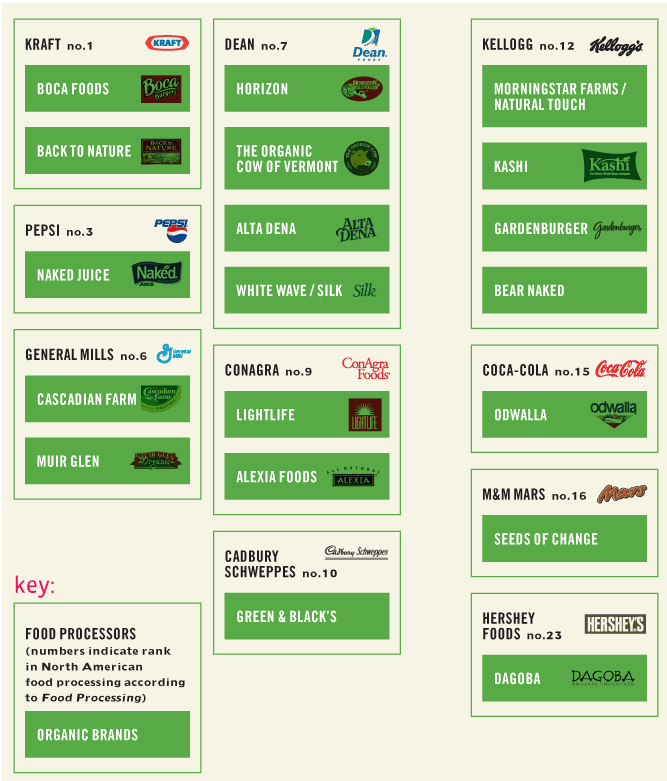
    Who owns your favorite organic brand?

    I never would have imagined that my favorite smoothie drink and Coca-Cola had anything in common. Until I found out that Coca-Cola owns Odwalla. Odwalla, which promotes itself as "the juice company with a conscience", was started in 1980 by three jazz musician friends who started making juice out of a box of oranges in California. Their plan was to make enough profit to help fund music programs in local schools. The company flourished from its humble beginnings, but was purchased by Coco-Cola in 2001 for a cold  $181 million.


    The more I searched, the more I found similar stories of organic brands owned by large corporations:
    Morningstar and Kashi ( Kellogg)
    Horizon (Dean Foods)
    Boca Foods ( Kraft)
    Earth’s Best (Heinz)
    Cascadian Farms (General Mills)
    Naked Juice (Pepsi)

    Coca-Cola, Pepsi and other parent companies had tried hard to capture the organic market for years, without much success. Their solution has been simple: If you can't beat them, buy them!  The controversy this produces in the 'all natural' world is huge.

    On the one hand are a group of cynics who argue that "natural doesn't mean much" these days. The practice of organic farming is highly incompatible with the factory farming methods needed for mass-production. Furthermore, many people believe that the ownership of organic brands by corporate giants makes these organic companies guilty by association. There's no saying how much bad influence spills over into the management of these smaller organic brands. Unless you grew it and baked it yourself, it's very hard to know how organic and sustainable your food is, and by extension, the companies that produced it.

    On the other hand, as major conglomerates are financing and working to keep these brands successful, this has allowed healthy-er versions of foods and drinks to appear on supermarket shelves all across America. Indirectly, Coco-Cola, Kellogg, Pepsi and the others are ensuring a large supply of organic foods, which increases competition and drives down the prices. If we increase the public's awareness of natural foods by having organic brands produced on a mass-scale, people hopefully will soon push for small, local and sustainable farmers and companies. We may be loosing the battle by buying organic food owned by large companies, but when it comes to increasing the popularity of organic and healthy food alternatives, we are winning the war.

    So the final judging moment is here and I straddle the fence. Both arguments are valid - there is a need for more readily available organic products on a mass-scale, and yet the means of achieving this often involves sharing a bed with these larger corporate giants. The solution seems clear:  until the public begins to vote en-mass with their dollar for the small, sustainable, local food companies, this pattern of ownership by large corporations will likely continue.

    Check out this amazing chart produced by Phil Howard and write a comment below to cast your vote on whether ownership by a corporate giant is a big no-no for an organic brand.


    OVERALL RATING (of large corporations buying your favorite organic brand):
     

    Monday, June 21, 2010

    The World Cup goes Organic

    The English soccer team has a new "go healthy" campaign. The British soccer players are now eating less mashed potatoes and more organic and healthy food. High five!


    The team's health coach prepared a food list for the games in South Africa and the shipment from England included:
    - herbal tea
    - organic dark chocolate
    - seaweed sheets (for sushi, I imagine)
    - apricots
    - pine nuts
    - extra virgin olive oil

    They are buying their fresh fruits and vegetables locally in South Africa. I definitely support this movement towards more healthy and sustainable eating.

    OVERALL RATING:  A

    _________________________________________________________________________________

    It's not just the players who are going organic, their sponsors are too, or so they say... More World Cup products are being promoted as "organic and environmentally-friendly". Check out Nike's sport caps made of 10% organic cotton. That's right.... ten measly percent. Sorry Nike, but you don't just get to slap on an "eco-friendly" label because you've manufactured a product with a few strands of organic cotton!  That's like saying a McDonald's triple cheese burger is healthy because it has a piece of lettuce on it.

    OVERALL RATING: C

    _________________________________________________________________________________

    Nike has also started designing national team jackets out of, wait for it, recycled plastic bottles. The kits are made from discarded PET bottles that are collected from landfills in Taiwan and Japan. How do they do it? By melting the plastic, cutting fine shreds into yarn and then spinning the yarn into jackets. Each shirt is made from 8 recycled bottles, and Nike estimates that they've saved 13 million plastic bottles (or 29 soccer fields full). How's that for environmentally friendly?

    OVERALL RATING: A++

    Sunday, June 20, 2010

    Organic Father's Day Gift

    Wishing all the wonderful dads a great Father's Day! I woke up thinking, what better way to celebrate nature than by giving your dad a natural, organic gift? I found this website which boasts a large number of wholesome treats for father's day. Their best-selling item for dads is a canvas bag filled with salsa dips, organic tortilla chips, granola and dried apples.

    While the concept is fantastic, the gifts themselves don't have much "wow" value. Not to mention the steep price tag of $49 for the kit, without shipping. If you like the idea, run over to Whole Foods and make this gift bag yourself for half the price. You can even add your dad's favorite brands and make it more personal.

    OVERALL RATING: B+