Showing posts with label brand. Show all posts

Thursday, June 24, 2010

How Green is the new iPhone 4?


Today is the release day of the new Apple iPhone 4G, The excitement around it has reached all-new heights. It is sleeker, thinner, and more multi-functioning than its predecessors, but how green is the new iPhone? Let us count the ways:
  1. Enhanced reader apps prevent wastage of paper newspapers, books and magazines.
  2. Handset, headphones and USB cable are made from PVC-free materials.
  3. Bromine-free PCBs, mercury-free LCD display.
  4. Arsenic-free display glass.
  5. Packaging made from post-consumer recycled fiberboard and bio-based materials.
  6. Power adapter that outperforms strictest global energy efficiency standards.
  7. A larger battery requiring less charge-time.
It gets a few points as a marginal improvement over the iPhone 3G, but Apple could definitely have wow-ed us with a mind-blowing eco-friendly feature. Steve, maybe the next one...


P.S. - If you're looking for an iPhone 4 cover, check out these cool bamboo cases that come with a clear conscience.


And here are my top 5 eco-friendly (free!) apps to try.

GoodGuide – A green and ethical shipping guide with a database of over 50,000 products It can scan product barcodes and tell you whether to buy something or leave it on the shelf.

Find Green – Tells you all the places near you that are eco-friendly. This is basically Yelp... gone green.

Skeptical Science – It lays out the most common arguments by enviro-skeptics and then offers you a both in-depth and succinct counterargument.

Carbon Tracker - A GPS-enabled carbon footprint app that allows you to calculate your carbon footprint from daily commuting, business trips or vacations. You can also create goals for maximum monthly emissions, and monitor your progress.

Pollution – If you’ve ever wondered how clean the air you breathe is, this app will pull real-time air pollution data for 1,380 cities worldwide.


OVERALL RATING (of the new iPhone 4) :

Wednesday, June 23, 2010

Who owns your favorite organic brand?

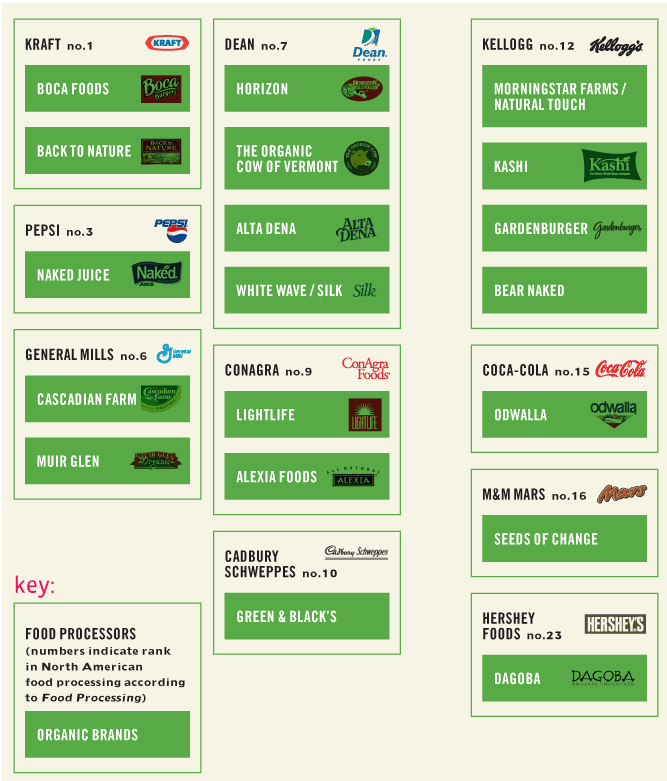
I never would have imagined that my favorite smoothie drink and Coca-Cola had anything in common. Until I found out that Coca-Cola owns Odwalla. Odwalla, which promotes itself as "the juice company with a conscience", was started in 1980 by three jazz musician friends who started making juice out of a box of oranges in California. Their plan was to make enough profit to help fund music programs in local schools. The company flourished from its humble beginnings, but was purchased by Coco-Cola in 2001 for a cold  $181 million.


The more I searched, the more I found similar stories of organic brands owned by large corporations:
Morningstar and Kashi ( Kellogg)
Horizon (Dean Foods)
Boca Foods ( Kraft)
Earth’s Best (Heinz)
Cascadian Farms (General Mills)
Naked Juice (Pepsi)

Coca-Cola, Pepsi and other parent companies had tried hard to capture the organic market for years, without much success. Their solution has been simple: If you can't beat them, buy them!  The controversy this produces in the 'all natural' world is huge.

On the one hand are a group of cynics who argue that "natural doesn't mean much" these days. The practice of organic farming is highly incompatible with the factory farming methods needed for mass-production. Furthermore, many people believe that the ownership of organic brands by corporate giants makes these organic companies guilty by association. There's no saying how much bad influence spills over into the management of these smaller organic brands. Unless you grew it and baked it yourself, it's very hard to know how organic and sustainable your food is, and by extension, the companies that produced it.

On the other hand, as major conglomerates are financing and working to keep these brands successful, this has allowed healthy-er versions of foods and drinks to appear on supermarket shelves all across America. Indirectly, Coco-Cola, Kellogg, Pepsi and the others are ensuring a large supply of organic foods, which increases competition and drives down the prices. If we increase the public's awareness of natural foods by having organic brands produced on a mass-scale, people hopefully will soon push for small, local and sustainable farmers and companies. We may be loosing the battle by buying organic food owned by large companies, but when it comes to increasing the popularity of organic and healthy food alternatives, we are winning the war.

So the final judging moment is here and I straddle the fence. Both arguments are valid - there is a need for more readily available organic products on a mass-scale, and yet the means of achieving this often involves sharing a bed with these larger corporate giants. The solution seems clear:  until the public begins to vote en-mass with their dollar for the small, sustainable, local food companies, this pattern of ownership by large corporations will likely continue.

Check out this amazing chart produced by Phil Howard and write a comment below to cast your vote on whether ownership by a corporate giant is a big no-no for an organic brand.


OVERALL RATING (of large corporations buying your favorite organic brand):