Showing posts with label corporate. Show all posts

Monday, June 28, 2010

The Gulf Oil Spill (and what you can do about it)


Pelicans captured at Grand Isle, Louisiana, following the BP oil spill in the Gulf. 
Photo Credit: International Bird Rescue Research Center

As the worst oil spill in American history, BP's Gulf Oil Spill gets an F. The effects of the spill and subsequent damage to the communities and species along the coast are immeasurable. Hundreds of thousands of barrels are leaked each day and Mother Nature simply doesn't have the means to fix our problem. Among the horrors of the gulf spill are:

1) Extreme sickness caused by chemicals - The toxins in the oil have been reported to cause legions in the brain and clog the lungs. Fishermen and children who have been exposed to the spill are already showing signs of severe illness.

2) Extinction of animals - The National Wildlife Federation reports that already more than 150 threatened or endangered sea turtles are dead. And 316 sea birds, mostly brown pelicans and northern gannets, have been found dead along the Gulf Coast as a result of the spreading oil.

3) Worsening Hurricanes - As the Gulf Coast is prime hurricane country, if a storm blows in, the result could be devastating. The presence of oil could lead to a more powerful hurricane because crude accumulating at the surface could be raising the temperature of the surrounding water.

Scientists have employed the use of genetically-altered bateria designed to eat the oil. This solution gets some credit as an organic solution to this devastating crisis. Will these super-oil-eating bacteria be enough, however? Only time will tell.

OVERALL RATING:  


Looking to Help?
If you're looking for ways to help, even in the smallest way possible, here are some great ideas from Oceana:

1)  Tell Obama and Congress to stop offshore drilling. Sign the petition here.

2)  Help distribute this petition in your neighborhood and send back your signatures to Oceana, c/o Stop the Drill 1350 Connecticut Ave, NW 5th Floor Washington, DC 20036 or fax them to 202.833.2070.

3)  Sign up to find volunteer opportunities in your area.

Flyover of the Deepwater Horizon site with the US Coast Guard on Wed May 19th 2010. 
Photo by: David Rencher


Thursday, June 24, 2010

How Green is the new iPhone 4?


Today is the release day of the new Apple iPhone 4G, The excitement around it has reached all-new heights. It is sleeker, thinner, and more multi-functioning than its predecessors, but how green is the new iPhone? Let us count the ways:
  1. Enhanced reader apps prevent wastage of paper newspapers, books and magazines.
  2. Handset, headphones and USB cable are made from PVC-free materials.
  3. Bromine-free PCBs, mercury-free LCD display.
  4. Arsenic-free display glass.
  5. Packaging made from post-consumer recycled fiberboard and bio-based materials.
  6. Power adapter that outperforms strictest global energy efficiency standards.
  7. A larger battery requiring less charge-time.
It gets a few points as a marginal improvement over the iPhone 3G, but Apple could definitely have wow-ed us with a mind-blowing eco-friendly feature. Steve, maybe the next one...


P.S. - If you're looking for an iPhone 4 cover, check out these cool bamboo cases that come with a clear conscience.


And here are my top 5 eco-friendly (free!) apps to try.

GoodGuide – A green and ethical shipping guide with a database of over 50,000 products It can scan product barcodes and tell you whether to buy something or leave it on the shelf.

Find Green – Tells you all the places near you that are eco-friendly. This is basically Yelp... gone green.

Skeptical Science – It lays out the most common arguments by enviro-skeptics and then offers you a both in-depth and succinct counterargument.

Carbon Tracker - A GPS-enabled carbon footprint app that allows you to calculate your carbon footprint from daily commuting, business trips or vacations. You can also create goals for maximum monthly emissions, and monitor your progress.

Pollution – If you’ve ever wondered how clean the air you breathe is, this app will pull real-time air pollution data for 1,380 cities worldwide.


OVERALL RATING (of the new iPhone 4) :

Wednesday, June 23, 2010

Who owns your favorite organic brand?

I never would have imagined that my favorite smoothie drink and Coca-Cola had anything in common. Until I found out that Coca-Cola owns Odwalla. Odwalla, which promotes itself as "the juice company with a conscience", was started in 1980 by three jazz musician friends who started making juice out of a box of oranges in California. Their plan was to make enough profit to help fund music programs in local schools. The company flourished from its humble beginnings, but was purchased by Coco-Cola in 2001 for a cold  $181 million.


The more I searched, the more I found similar stories of organic brands owned by large corporations:
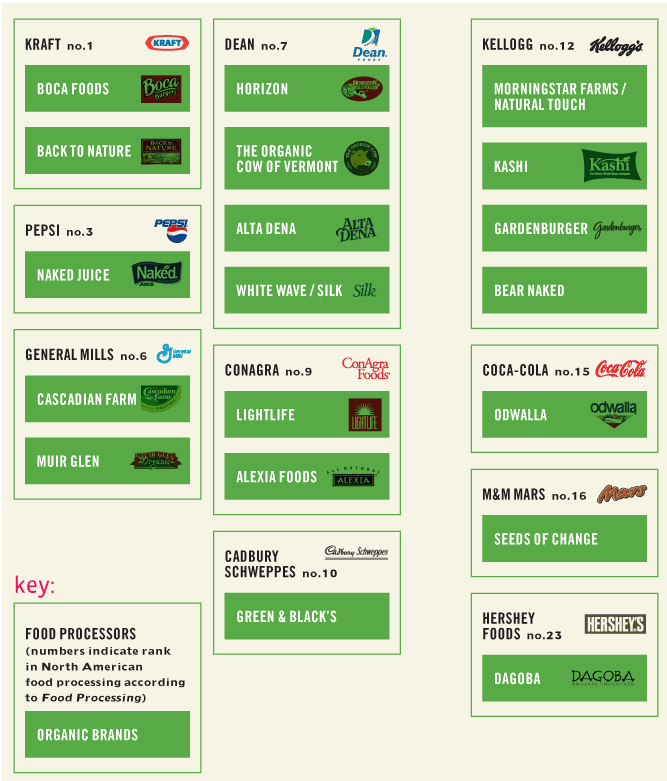
Morningstar and Kashi ( Kellogg)
Horizon (Dean Foods)
Boca Foods ( Kraft)
Earth’s Best (Heinz)
Cascadian Farms (General Mills)
Naked Juice (Pepsi)

Coca-Cola, Pepsi and other parent companies had tried hard to capture the organic market for years, without much success. Their solution has been simple: If you can't beat them, buy them!  The controversy this produces in the 'all natural' world is huge.

On the one hand are a group of cynics who argue that "natural doesn't mean much" these days. The practice of organic farming is highly incompatible with the factory farming methods needed for mass-production. Furthermore, many people believe that the ownership of organic brands by corporate giants makes these organic companies guilty by association. There's no saying how much bad influence spills over into the management of these smaller organic brands. Unless you grew it and baked it yourself, it's very hard to know how organic and sustainable your food is, and by extension, the companies that produced it.

On the other hand, as major conglomerates are financing and working to keep these brands successful, this has allowed healthy-er versions of foods and drinks to appear on supermarket shelves all across America. Indirectly, Coco-Cola, Kellogg, Pepsi and the others are ensuring a large supply of organic foods, which increases competition and drives down the prices. If we increase the public's awareness of natural foods by having organic brands produced on a mass-scale, people hopefully will soon push for small, local and sustainable farmers and companies. We may be loosing the battle by buying organic food owned by large companies, but when it comes to increasing the popularity of organic and healthy food alternatives, we are winning the war.

So the final judging moment is here and I straddle the fence. Both arguments are valid - there is a need for more readily available organic products on a mass-scale, and yet the means of achieving this often involves sharing a bed with these larger corporate giants. The solution seems clear:  until the public begins to vote en-mass with their dollar for the small, sustainable, local food companies, this pattern of ownership by large corporations will likely continue.

Check out this amazing chart produced by Phil Howard and write a comment below to cast your vote on whether ownership by a corporate giant is a big no-no for an organic brand.


OVERALL RATING (of large corporations buying your favorite organic brand):